Use the current booking channel linked from the official Ministry park page, which announced a new platform in May 2026. Check the entry price for your date and visitor category, required documents and closures; confirm whether entry is included in your chosen tour. Official park page.
When is the best time to visit Kawah Ijen?
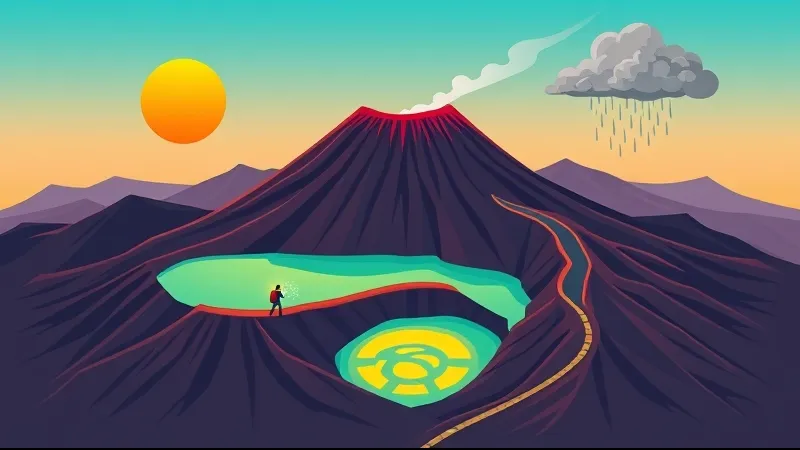
The best time to visit Kawah Ijen is the dry season, roughly May to October (some years it starts as early as April), and within that window July to September is the driest and clearest for the pre-dawn hike. In these months you get the highest odds of firm trails, low fog on the crater rim and a cloud-free sunrise over the turquoise acid lake. The rainy season, roughly November to April with its wettest weeks around February, is not impossible, but the volcanic gravel turns slippery, views cloud over more often and rain-related trail closures become more likely.
The crater rim, sunrise and lake are planned highlights, but gas conditions, weather and official restrictions can prevent access or visibility.
Quick verdict: come in the dry season if you can, aim for July–September for the clearest skies, keep your plans flexible in the wet months, and always check official volcano status before you commit to a date.
What is the difference between dry season and rainy season at Kawah Ijen?
East Java has a two-season tropical climate: a dry season roughly May–October (in some years already underway in April) and a rainy season roughly November–April, driven by the monsoon reversal tracked by BMKG, Indonesia's meteorological agency. There is no snow and no autumn — just wet and dry — so the calendar for hikers is really a calendar of rain and cloud.
What actually changes on the ground:
- Sky clarity. Dry-season nights are far more likely to give you clear stars and a clean horizon for sunrise. Low cloud and fog can obscure both sunrise and the lake, especially in wet weather.
- Trail surface. The ~3 km path from Paltuding is loose volcanic gravel. Dry, it packs firm and grips well. Wet, it turns slick and muddy, and the steeper switchbacks near the top become genuinely awkward in the dark.
- Closure risk. Heavy rain raises the chance of temporary trail closures for safety, and the wet season is when most weather-related restrictions occur. Combined with an active volcano's own gas-related closures, November–April simply carries more "we couldn't go up today" risk.
Neither season removes the sulfur smell, the cold or the lost sleep — those are constants. What the dry season buys you is better odds, not a guarantee.
What is the weather like on the Kawah Ijen hike at night?
The Kawah Ijen hike is a cold, dark, high-altitude walk, even though this is tropical Indonesia. The uphill trail from Paltuding to the crater rim is approximately 3 km each way; allow roughly 1.5–2 hours up, depending on pace and conditions. Because the gate at Paltuding opens at 02:00 and the climb happens in the small hours, you are hiking through the coldest part of the night.
Bring warm layers and a windproof shell for the exposed rim, and check the BMKG forecast before departure.
One constant regardless of season: the sulfur gas. Near the crater the fumes sting the eyes and throat, which is why tours provide gas masks and they are mandatory near the crater floor. For a fuller kit and timing breakdown, see the Ijen sunrise tour from Banyuwangi page.
How does Kawah Ijen change month by month?
These months describe a broad seasonal pattern, not a calendar that repeats identically each year. Check the latest BMKG outlook and the forecast for your travel dates, together with trail and park-access conditions.
- April–May — the wet season winds down and the dry season begins. In many years the rains taper through April and the dry season settles in by May; trails firm up and crowds are thinner than mid-season. Clarity improves week by week, with the occasional lingering shower.
- June — early dry season. Reliably dry on most nights, with skies clearing steadily as the driest stretch approaches. A strong month that is often slightly quieter than the peak.
- July–September — the driest, clearest core. The most reliable window: firmest trails, clearest skies and the best visibility for sunrise and the lake. Also the coldest clear nights, so pack warm. This is the busiest stretch on dry-season weekends and holidays.
- October — tail of the dry season. Trails generally firm and skies mostly clear, with temperatures creeping up and slightly more humidity as the season turns. A quieter alternative to peak months.
- November — the rains return. Fog and rain risk rise noticeably. Some nights are still clear; others cloud over the rim. Keep plans flexible from here on.
- December–February — the wettest stretch, peaking around February. Frequent slippery paths, higher chance of clouded-out sunrises and the greatest likelihood of rain-related closures. Doable, but with the lowest odds of a clear view.
- March–April — tail of the wet season. Rain gradually tapers, but trails can still be muddy and skies unsettled. Improves toward the start of the dry season in May — or already in late April in a good year.
If you only have one rule: aim for July–September for clarity, accept May–June or October as strong quieter alternatives, and go into November–April knowing you're trading odds for flexibility.
Can you see the sunrise and the turquoise crater lake at any time of year?
The crater rim, sunrise and lake are planned highlights, but gas conditions, weather and official restrictions can prevent access or visibility.
The turquoise crater lake is highly acidic. NASA’s account of 6 September 2014 described a pH below 0.3; this is a historical observation, not a current measurement. See also: Ijen UNESCO Global Geopark.
Clear weather can improve the chance of seeing sunrise and the lake; clouds, gas and restrictions can still prevent the visit.
Is the blue fire visible in every season?
No — and it is important to be plain about this. The blue fire is never guaranteed in any season. The electric-blue flames come from sulfuric gases igniting on contact with air (flames can reach up to ~5 m), and they are only visible in darkness, roughly 02:00 to 04:30, and only from inside the crater, where you descend a steep, rocky path toward the vents — not from the rim.
Whether they show depends on gas flow, weather and ongoing sulfur mining works, not on the calendar. On top of that, the authorities suspend and reopen the crater descent depending on gas readings and works, and some suspensions have lasted months, including in recent years — the clearest possible proof that no season and no tour can promise it. Dry, clear, moonless nights improve your chances by keeping the crater dark and visibility good — but that is a nudge to the odds, not a booking guarantee.
Treat the blue fire strictly as a bonus. If you build the trip around it and the vents are quiet, you'll be disappointed; if you build the trip around the sunrise and lake and then catch the flames too, it's a gift. Before you book with the blue fire in mind, check current conditions on official sources (see below), and read sunrise hike vs midnight blue fire trek to understand what each option really delivers. A quick note of respect, too: the flames sit among sulfur miners still working inside the crater, carrying loads of ~75–90 kg — never treat them as an attraction, and always ask before taking a photo.
Does Kawah Ijen ever close, and how do you check before you go?
Yes. Kawah Ijen is an active volcano, monitored by Indonesia's PVMBG / MAGMA Indonesia and managed by the BBKSDA East Java park authority, and access can be restricted for volcanic gas levels, alert-status changes or heavy rain. Closures are most common in the wet season, but a gas-related restriction can happen at any time — which is exactly why you should never assume a date is safe without checking.
Before you book a specific night, do two things:
- Check the official volcano status on MAGMA Indonesia and the BBKSDA East Java park announcements. Do not rely on a tour operator's marketing or on a status you read online months ago — and never take my word for the current status, because it changes.
- Use the current booking channel linked from the official Ministry park page, which announced a new platform in May 2026. Check the entry price for your date and visitor category, required documents and closures; confirm whether entry is included in your chosen tour.
The park requires a doctor-issued health certificate dated no more than three days before the visit. It advises against hiking with a history of heart disease, asthma, acute respiratory infection or other respiratory disorders. Seek individual medical advice, including during pregnancy; a certificate or mask does not guarantee safety.
How should you plan the trip around the best season?
Most hikers base in Banyuwangi town, roughly a 1 to 1.5-hour drive from Paltuding: tours pick up around midnight–00:30 so the climb can start when the gate opens at 02:00, reaching the rim in time for sunrise. Coming from Bali is a long overnight trip: about a 4–5 hour drive to Gilimanuk, a 45–60 minute ferry to Ketapang, then another 1–1.5 hours to the base — plan for a full night with little sleep. The getting there and transport pages lay out both approaches in detail.
Weekdays may be quieter; check the actual entry tariff for your date instead of assuming a weekday discount. Compare the transfer options: Ijen tour from Bali vs Banyuwangi.
For live prices, ratings and availability, check the tour comparison pages rather than any figure quoted in an article — those numbers move, and only the widgets show current data.
Planning your window? Start with the best Ijen tour comparison to line up guided options against your travel dates and see live availability for the dry-season months.
Frequently asked questions about the best time to visit Kawah Ijen
What months have the least rain at Kawah Ijen?
July to September are the driest and clearest, within the broader dry season of roughly May–October. Low cloud and fog can obscure both sunrise and the lake, especially in wet weather.
Is July too cold for the Ijen hike?
Bring warm layers and a windproof shell for the exposed rim, and check the BMKG forecast before departure.
Can I do the Kawah Ijen hike in the rainy season?
Yes, but with lower odds. Between November and April the volcanic gravel gets slippery, fog often clouds the view, and rain-related closures are more likely. Keep flexible dates and check official status, because the trail can shut on short notice.
Is the blue fire guaranteed in the dry season?
No — it is never guaranteed in any season. The blue fire depends on gas flow, weather and sulfur mining works, and the authorities have suspended crater access for months at a time, including recently. The rim hike, sunrise and lake are planned highlights, subject to gas conditions, weather, visibility and official access restrictions. Blue fire is not guaranteed.
What time does the Ijen trail open, and do I need a guide?
Use the current booking channel linked from the official Ministry park page, which announced a new platform in May 2026. Check the entry price for your date and visitor category, required documents and closures; confirm whether entry is included in your chosen tour.
Sources
-
Ijen UNESCO Global Geopark — crater lake status, geology and protected-area designation
-
PVMBG / MAGMA Indonesia — official volcano monitoring and alert status
-
BBKSDA East Java park authority — park rules, closures and the official e-ticket system
-
BMKG — Indonesian Agency for Meteorology, Climatology and Geophysics — dry- and rainy-season climate for East Java
-
Smithsonian Global Volcanism Program — Ijen — volcano background and eruptive history
-
van Hinsberg et al., Journal of Volcanology and Geothermal Research — peer-reviewed research on the Kawah Ijen acid crater lake (pH, dimensions and chemistry)