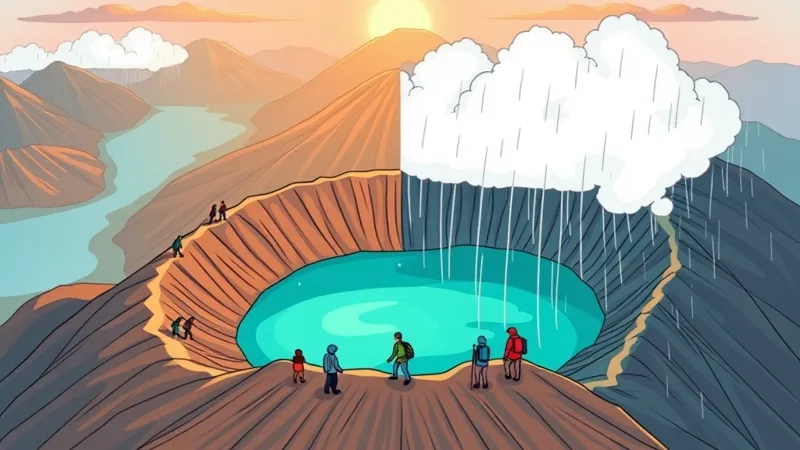
What weather should you expect at Kawah Ijen throughout the year?
Expect a cold pre-sunrise hike year-round, generally wetter conditions from November–March, and a generally drier May–September window. April and October are approximate transitions, not fixed boundaries: rain can extend into April, while October can remain dry.
The commonly cited summit elevation is 2,386 m, not the elevation of every viewpoint. Plan around the crater-rim hike, sunrise and turquoise lake; clear views depend on weather, and blue fire is never guaranteed.
Quick answer: Night temperatures at the rim are often 2–10°C, so carry warm layers in every month. This is a general planning range, not a monthly average or forecast. Favor the drier season for clearer-view opportunities, not certainty. Use BMKG for regional seasonal outlooks and local weather warnings.
How does Kawah Ijen weather change month by month?
Use monthly seasonal tendencies to choose a travel window, not to predict a particular morning. The comparison below describes rain, cloud and packing implications; it does not assign monthly air temperatures or substitute coastal Banyuwangi conditions for the mountain.
- January: Wet-season tendency; rain and cloud can interrupt views. Keep insulation in a dry bag.
- February: Typically the wetter peak; allow extra flexibility for heavy rain. Prioritize waterproof protection.
- March: Generally wet; fog and showers remain relevant. Carry dry spare layers.
- April: Variable transition, sometimes still rainy. Keep the full wet-weather kit.
- May: Usually becoming drier; showers remain possible. Retain a waterproof shell.
- June: Generally drier; cloud can still obscure the lake. Pack insulation for waiting.
- July: Among the driest months, but not reliably cloud-free. Keep gloves and warm layers.
- August: Generally dry-season conditions; exposed stops can feel cold. Carry wind protection.
- September: Usually favorable for clearer-view opportunities. Do not leave rainwear behind.
- October: Transition conditions; dry weather may persist or rains develop. Protect spare clothing.
- November: Rain generally becomes more likely. Emphasize grip and waterproofing.
- December: Wet-season conditions; cloud may hide sunrise and the lake. Build in schedule flexibility.
BMKG seasonal outlooks help refine this broad eastern Java pattern for the particular year; calendar labels alone cannot predict a hike.
How cold is Kawah Ijen at 2,386 m before sunrise?
Prepare for cold, especially when stationary at the rim. Night temperatures are often 2–10°C. Treat that as a general packing guide, not a measured monthly average, a daytime range or a guaranteed forecast.
Paltuding base camp is at approximately 1,841 m. The route climbs toward the high crater rim, commonly described around 2,386 m; that summit figure should not be assigned to every stopping point.
Air temperature is distinct from wind chill and the discomfort of wet clothing. Walking uphill generates heat; waiting for sunrise does not. Neither a warm reading during the climb nor a coastal forecast represents an exposed rim stop. A generic elevation calculation is not local climate evidence.
What does the rainy season change on an Ijen hike?
Rain mainly changes footing, comfort, visibility and timing—not automatically legal access. Wet sections can become slippery, clothing can soak through, and fog or cloud can conceal the turquoise lake. Heavy rain may also slow road transfers.
Wet-season days are not uniformly rainy, and dry-season paths are not always dry. Thunderstorms warrant particular caution on exposed terrain: follow warnings and instructions rather than pressing on for a photograph.
Poor visibility and an official closure are different situations. Consult BMKG warnings and BBKSDA Jawa Timur access notices. Leave room for delays or changed plans; an early departure does not guarantee avoiding rainfall.
Which months are usually better for sunrise and lake views?
May–September generally offers better opportunities, with July–September commonly the driest part of the season. October can remain dry, while April may mark an early transition or retain wet-season conditions.
- Prioritizing clearer views: Favor July–September, accepting that clouds still occur.
- Flexible travel dates: Consider the broader drier window and adjust around short-term forecasts.
- Traveling in the wet season: Keep expectations realistic and allow alternatives if weather disrupts the hike.
El Niño and La Niña can influence seasonal timing and rainfall. Use BMKG’s evolving seasonal outlook rather than assuming identical annual boundaries. No month guarantees a visible sunrise or unobscured lake.
Which weather forecast should you check before visiting Kawah Ijen?
Check mountain-relevant weather, volcanic advisories and access notices separately. A favorable forecast does not establish that the route is open.
- Several days before travel: Review rainfall trends, thunderstorm potential and transfer flexibility.
- The day before: Check precipitation timing, wind and cloud. Confirm the forecast location and elevation; nearby lowland conditions can mislead.
- Immediately before setting out: Recheck BMKG warnings, MAGMA Indonesia volcanic advisories and BBKSDA Jawa Timur visitor notices.
Monthly patterns guide trip planning, not a particular morning. Forecast uncertainty, volcanic hazards and legal access are separate considerations.
How should weather affect your transfer and hiking schedule?
Allow weather buffers and confirm permitted entry hours before planning a sunrise arrival. Overnight entry should never be assumed.
- Banyuwangi town to Paltuding: Approximately 1–1.5 hours driving one way. Road distance depends on the actual departure point and route.
- Bondowoso to Paltuding: Confirm the departure address, route and expected duration with your transport provider rather than applying Banyuwangi timings.
- Paltuding to the crater rim: Approximately 3 km one way, around 545 m of elevation gain, and 1.5–2 hours uphill. These are not return-trip figures. The trail is steep but non-technical.
Rain, traffic, fitness and stops change timing. See getting to Ijen for route planning. To weigh transfer length and lost sleep, compare tours from Bali and Banyuwangi; live commercial details belong in the comparison page’s widgets.
What should you wear and pack for Ijen in wet and dry months?
Use adjustable layers year-round, with extra attention to keeping insulation dry in wetter months. Pack for the climb and the colder stationary stop separately.
- Moisture-managing base layer: Useful throughout the year; avoid remaining in sweat-soaked clothing.
- Insulating layer: Carry in every season and add it when stopping.
- Windproof waterproof shell: Useful in dry months too; especially important in sustained rain.
- Grippy footwear: Needed year-round, with greater care on wet ground.
- Headlamp: Essential whenever the permitted itinerary includes darkness.
- Gloves: Useful for cold, exposed waits.
- Dry bag: Protect spare layers, not just electronics; rainwear cannot help if your insulation is already soaked.
Rainwear and ordinary face coverings do not protect against volcanic gases. Equipment never overrides restrictions or instructions to withdraw. Sulfur irritation, cold and sunrise crowds can all affect comfort.
Does rain affect the chance of seeing Ijen’s blue fire?
Rain can affect visibility, but the month alone does not determine blue-fire sightings. The phenomenon comes from sulfur gases burning and is visible only in darkness.
Gas flow, mining works, weather and official restrictions all matter. Authorities may suspend crater-floor access because of gas readings, volcanic activity or mining works; suspensions can last months.
The crater rim, sunrise hike and lake remain the core itinerary when access permits, although weather can hide the views. Blue fire is an optional bonus, never a promise. Check MAGMA Indonesia and BBKSDA Jawa Timur before booking; geological information is not a live sighting forecast.
What else should you know about Kawah Ijen weather?
Plan for year-round cold and check conditions for your actual departure.
Is Ijen cold in July?
Yes, it can feel cold before sunrise despite July’s generally drier weather. Carry insulation, gloves and a windproof shell.
Can you visit in December or January, and does rain close the trail?
Visits may be possible when access is permitted. Rain does not automatically mean closure, but warnings or official restrictions may change plans.
Is a Banyuwangi forecast suitable for the crater rim?
Not by itself. Coastal temperature and cloud conditions do not represent the higher, exposed route. Check the forecast location and elevation.
Does clear weather guarantee blue fire?
No. Darkness, gas conditions, mining works and permitted crater access also matter. Check official notices before booking.
What should you do when clouds obscure the lake?
Stay within permitted areas and follow safety instructions. Allow schedule flexibility if practical, but do not assume that waiting longer guarantees clearing.
Sources
Weather forecasts, geological background and access notices answer different questions. Use the relevant official resource when planning your visit; none guarantees clear views or a blue-fire sighting.
- BMKG: regional seasonal outlooks, forecasts and weather warnings.
- Smithsonian Global Volcanism Program: volcanic elevation and geological background.
- MAGMA Indonesia: volcanic advisories, not blue-fire sighting predictions.
- BBKSDA Jawa Timur: official visitor access information and restrictions.