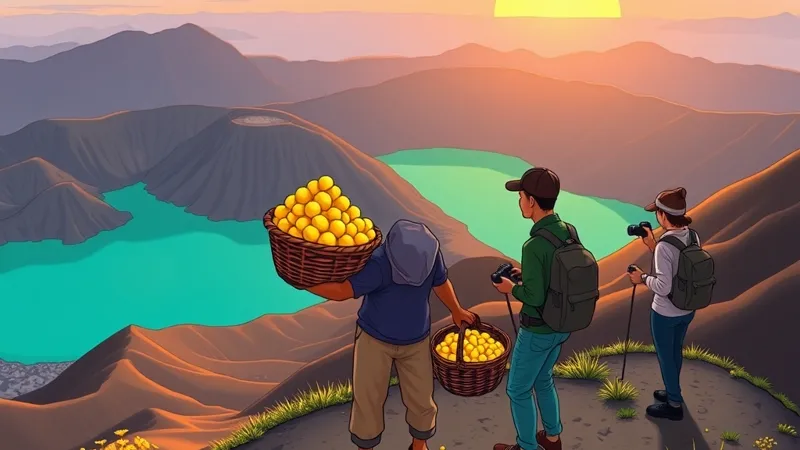
Who are Kawah Ijen’s sulfur miners, and how can visitors respect them?
Kawah Ijen’s sulfur miners collect solidified sulfur and transport it from the crater for sale. Respect their work by giving them priority, asking before photographing them and never blocking their routes or touching equipment. Workers are not a tourist attraction.
The core visit is the crater-rim hike, sunrise viewing and the turquoise acid lake, subject to weather and official access restrictions. Blue fire is only a possible bonus: it depends on gas flow, mining works, darkness and permitted access, and is never guaranteed.
An ethical Kawah Ijen visit starts with recognizing that your walking holiday overlaps with somebody else’s workplace. Plan around the permitted visitor route, not around obtaining an encounter or photograph.
How is sulfur collected and transported at Kawah Ijen?
Sulfur collection involves channeling volcanic gases through pipes, allowing sulfur to cool and solidify, then breaking it into transportable pieces. The Smithsonian Global Volcanism Program’s Ijen profile provides geological context for the crater’s sulfur-producing fumaroles.
The extraction area, climb to the rim and onward journey are distinct stages. Workers collect sulfur near the gas outlets, carry pieces uphill in baskets and move the material onward toward weighing and sale. Carrying arrangements and other transport equipment can differ along the route; not every stage is a basket-carrying ascent.
This description is not an invitation to approach collection pipes or follow workers downhill. Extraction areas and occupational routes are not automatically open to visitors.
What should readers understand about loads, earnings and working conditions?
No single load or earnings figure describes every miner’s working day. Individual capacity, trip frequency, sulfur collected and payment arrangements all affect the picture.
Useful evidence needs these distinctions:
- Load: kilograms per carried load are different from the total transported during a working day. Exceptional loads should not be presented as universal.
- Payment basis: payment for accepted sulfur by weight should be distinguished from a daily wage and from souvenir or photography income.
- Earnings: gross receipts in Indonesian rupiah are not necessarily take-home earnings after work-related expenses.
- Hours: collection, carrying, waiting and onward transport all matter; hiking time alone does not describe a shift.
- Date and scope: a dated interview describes that worker’s account at that time. A study’s sample cannot automatically represent everyone working at Ijen.
Historical wage estimates should never become present-day salary claims. Equally, an account of difficult conditions does not justify guessing why someone continues the work. Workers’ own explanations deserve priority over narratives of helplessness or exceptional endurance.
What health hazards do miners face, and what should visitors understand?
Miners face repeated occupational gas exposure and physical strain; visitors generally have shorter exposure, but shorter does not mean safe. Carrying heavy material on steep ground adds demands that a recreational hike does not replicate.
The NIOSH Pocket Guide identifies sulfur dioxide as a respiratory irritant. Wind shifts can change exposure quickly. Cloth masks and particulate-only masks do not protect against sulfur dioxide, and a rental respirator is not a guarantee of safety: suitable equipment, fit and conditions matter.
If gas affects you, leave the affected area and follow official instructions. Do not rely on smell, a mask or a guide’s reassurance to decide that remaining is safe.
Travelers with respiratory conditions should seek individualized medical advice before planning the hike and check official entry requirements. A medical discussion is not a substitute for complying with access restrictions.
How should visitors behave when meeting or photographing miners?
Give workers space and obtain consent before photographs or recordings. A narrow trail is a transport route, not a place to stop somebody for a portrait.
- Yield at a safe passing point without stepping onto unstable ground.
- Leave clearance for baskets and projecting loads, not just the person carrying them.
- Ask before taking photographs; accept a refusal without negotiation.
- Avoid sudden flash, intrusive close-ups and filming someone in distress.
- Do not touch equipment, stage labor scenes or lift baskets for entertainment.
- Save questions for a willing conversation during a genuine break.
Consent to a photograph does not automatically include commercial publication. Explain the intended use and obtain appropriate permission rather than assuming a friendly gesture covers advertising.
If a worker offers a posed photograph for payment, agree on the amount beforehand. Do not assume every worker wants money, attention or a conversation.
Can souvenirs or local guides support miners respectfully?
A voluntary purchase directly from a willing seller can provide income, but it does not prove that a wider mining community benefits. Ask who receives payment and respect a refusal to sell or discuss work.
Before buying sulfur items, check applicable carrier, transport and customs rules. Do not assume something sold near a tourist trail can travel in your luggage.
When comparing guides, look for local knowledge, clear worker-respect policies and transparent community contributions. Ask who receives any advertised donation and how the arrangement is documented. Tips and tour bookings should not be described as support for miners without evidence.
Visit Ijen is an independent editorial and affiliate guide, not a tour operator. Use our tour comparison pages to assess itineraries and consult the GetYourGuide listings there for live prices and ratings, rather than choosing solely on promises of blue fire or miner encounters.
How do travelers reach the trail, and how demanding is the hike?
The Paltuding-to-crater-rim hike is steep but non-technical. These approximate planning figures describe the visitor trail, not miners’ extraction routes:
- Starting point: Paltuding base camp, approximately 1,841 m.
- Destination: the crater rim, approximately 2,386 m—not the volcano’s summit.
- One-way distance: approximately 3 km.
- Elevation gain: approximately 545 m.
- Typical ascent: 1.5–2 hours, with variation for fitness, stops and trail conditions.
- Descent: allow a separate return-walk margin; fatigue, congestion and wet ground can slow progress.
- Banyuwangi town to Paltuding: approximately 1–1.5 hours by road, depending on pickup location and conditions.
- Bondowoso to Paltuding: request an estimate tied to your actual accommodation and route rather than treating district-wide travel times as interchangeable.
Consult BBKSDA East Java for official access notices and our getting-there guide for transport planning. Cold, lost sleep, sulfur irritation and sunrise crowds are real downsides; allow recovery time rather than scheduling a rushed onward journey.
Can visitors see miners and blue fire without entering the crater?
You may encounter workers on shared permitted routes, but neither miner encounters nor blue fire should be promised as an inclusion. Work schedules and transport arrangements are not organized around visitors.
Blue fire comes from burning sulfur gases and is visible only in darkness. Gas flow, mining works and access conditions affect whether a viewing opportunity exists; a rim-only itinerary should not promise visible flames.
The crater rim, sunrise and lake are the reliable itinerary focus, not guarantees of visibility. Weather can hide the lake or sunrise. Authorities can suspend or reopen crater-floor access, and restrictions can last months.
Check MAGMA Indonesia for volcanic advisories and the park authority’s access notices before booking. Miners’ presence below does not establish tourist permission, and a guide cannot override a closure. Our sunrise-versus-blue-fire comparison explains the itinerary trade-offs.
FAQ
These answers put consent and official access ahead of sightseeing expectations.
Can I photograph miners?
Yes, if the person gives permission and you do not obstruct work. Ask separately about recordings and commercial publication; consent to a photograph is not blanket permission for every use.
Should I pay for a photograph?
Agree beforehand if payment is requested for a posed photograph. Payment is not universally expected and never replaces consent.
Can I carry a miner’s basket?
Do not lift baskets for entertainment or touch them without permission. Loads and uneven ground create injury risks, and demonstrations can interrupt work.
Are miner encounters or blue fire guaranteed?
No. Miner encounters depend on work schedules and permitted routes. Blue fire depends on gas flow, mining works, darkness and access; prioritize the rim, sunrise and lake, with views subject to weather.
Can I descend if miners are working below?
No—not on that basis. Occupational access does not grant visitor access. Follow official restrictions even if workers are below or a guide suggests continuing.
Sources
Official sources serve different purposes; geological references do not establish current access or workers’ wages.
- Smithsonian Global Volcanism Program: Ijen — volcanic setting, sulfur activity and summit information, distinct from visitor viewpoint elevations.
- UNESCO: Ijen UNESCO Global Geopark — regional geological and cultural context.
- MAGMA Indonesia — official volcanic advisories.
- BBKSDA East Java — visitor access notices and park requirements.
- NIOSH Pocket Guide to Chemical Hazards — sulfur dioxide hazards and respiratory-protection context.