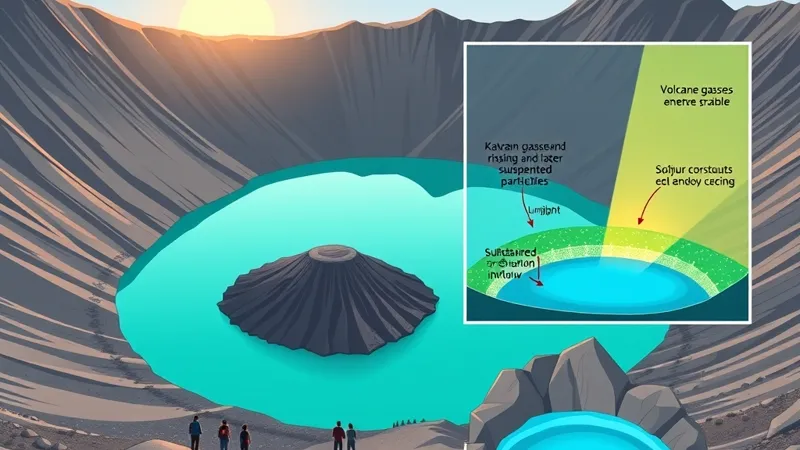
Why is the Ijen crater lake turquoise?
Ijen’s apparent turquoise color results from sunlight interacting with water, dissolved substances and suspended particles in a highly acidic volcanic lake. Acidity alone does not make water turquoise. The lake’s chemistry is well established; the precise contribution of individual substances to its appearance requires more specific optical evidence.
The Smithsonian Global Volcanism Program’s Ijen profile provides geological context for this acid crater lake. Its sulfur- and chlorine-rich chemistry helps explain the environment in which the color develops, but naming an acid or metal is not the same as demonstrating which wavelengths it absorbs or scatters.
For visitors, the useful distinction is simple: the color is natural, but it is not a direct measurement of acidity, temperature or volcanic safety.
Which substances and light effects influence Ijen’s lake color?
Selective absorption and scattering determine the light reaching your eyes; chemical composition alone cannot identify the dominant optical mechanism. Water absorbs different wavelengths unequally, while particles can scatter light back toward the surface.
Delmelle and Bernard’s Chemical Geology paper, “Geochemistry, mineralogy, and chemical modeling of the acid crater lake of Kawah Ijen Volcano, Indonesia,” is a foundational reference for the lake’s chemical system. Its chemical findings should not be treated automatically as a complete explanation of color.
The components have distinct roles:
- Dissolved sulfate: part of the sulfur-rich acid system. Its presence does not establish that sulfate itself produces turquoise water.
- Dissolved chloride: associated with volcanic chlorine inputs. Chloride abundance is chemical evidence, not proof of a blue-green pigment.
- Dissolved metals: released through interactions between acidic fluids and rock. Some metal species absorb visible light, but their contribution depends on concentration and chemical form.
- Suspended material: fine particles can scatter light. Their abundance and size matter separately from dissolved chemistry.
- Colloidal sulfur: a plausible scattering contributor in volcanic waters, but not a proven sole explanation for Ijen’s appearance without lake-specific optical measurements.
“Sulfur makes it turquoise” therefore compresses several different processes into an explanation that is too definite.
How acidic is Ijen’s lake, and what does pH mean?
Ijen is exceptionally acidic, but its pH is a measurement of particular water under particular conditions—not a permanent lake-wide constant. Any precise reading needs its sampling date, location and original analytical source.
The pH scale is logarithmic: a small numerical difference represents a substantial change in hydrogen-ion activity. Activity describes effective chemical behavior, rather than simply the total quantity of acid dissolved in the water. In concentrated solutions, that distinction matters. Negative pH is possible; the scale does not have an absolute lower boundary at zero.
Comparisons with household liquids can obscure differences in composition, concentration and exposure hazards. They are less useful than explaining what was actually measured.
“The most acidic large lake on Earth” is a widely used description, not a self-defining world record. Establishing that ranking requires a definition of “large” and comparable measurements from other lakes. “An exceptionally acidic volcanic crater lake” is the more defensible standalone description.
How do volcanic gases make the lake acidic?
Volcanic gases and hydrothermal fluids supply sulfur and chlorine compounds that generate and sustain acidity. Hydrogen chloride dissolves into water and contributes hydrogen ions; sulfur dioxide participates in reactions that can produce sulfuric acid and other sulfur species.
The USGS volcanic-gas guidance explains these general volcanic processes. Delmelle and Bernard’s Ijen research addresses the local relationships between acidic water, minerals and chemical reactions.
Acidic fluids alter surrounding rock, releasing dissolved elements. Rainfall dilutes and replenishes the lake, evaporation concentrates dissolved material, and water-rock reactions modify the solution. Changes in volcanic inputs and water balance mean that chemistry evolves over time. Sulfuric acid alone does not explain every lake property.
How warm and large is the lake, and does its color change?
Ijen is a substantial crater lake whose temperature, dimensions and appearance must be understood in their measurement context. Hydrothermal heating does not imply a uniform or permanently fixed water temperature.
Keep these reference points separate:
- Crater lake: a water surface inside the crater; its elevation is not the visitor-rim elevation.
- Visitor rim: approximately 2,386 m on the hiking itinerary, not a lake-level measurement or a summit elevation.
- Surface area and depth: dependent on water level and survey methods; a maximum depth is not an average depth.
- Water temperature and pH: dependent on sampling location, depth and time. A shoreline observation cannot automatically represent the entire lake.
Cloud cover, viewing angle, surface reflections and suspended material can alter apparent color. Camera white balance and image processing add further differences. Stronger daylight may reveal the turquoise more clearly than the subdued light around sunrise.
A color change alone is not a visitor-ready eruption forecast. Consult MAGMA Indonesia/PVMBG for official volcanic information rather than interpreting photographs as monitoring data.
Is the turquoise lake related to Ijen’s blue fire?
The lake’s daylight color and the blue flames are different phenomena within the same volcanic system. Blue fire comes from burning sulfur-rich gases. The lake does not glow blue, and the flames are not blue lava.
The flames are visible to visitors only in darkness. Blue fire is never guaranteed: gas flow, mining works, visibility, volcanic conditions and official restrictions all affect the experience. Authorities can suspend crater-floor access, sometimes for extended periods.
The crater rim, sunrise and lake views are the itinerary’s reliable core, still subject to weather and official access rules. Blue fire is only a possible bonus. Our sunrise hike versus midnight blue-fire trek comparison explains that planning trade-off.
How can visitors plan a hike to see the turquoise lake?
Plan around reaching the permitted rim for sunrise, with daylight lake viewing afterward if conditions and access allow. Approximate planning figures are:
- Paltuding to crater rim: around 3 km each way.
- Ascent: around 1.5–2 hours on a steep but non-technical trail.
- Elevation gain: approximately 545 m from Paltuding base camp at 1,841 m.
- Banyuwangi town to Paltuding: approximately 1–1.5 hours by road, depending on pickup location and conditions.
Confirm arrangements with your provider and check BBKSDA East Java for access requirements and MAGMA Indonesia for volcanic updates before booking. Our getting-there guide covers transport planning.
Expect lost sleep, cold conditions, sunrise crowds and possible sulfur smell or irritation. Photograph only from permitted viewpoints; better light never justifies crossing an exclusion boundary.
Compare itineraries through Visit Ijen’s independent tour comparisons. Visit Ijen is an editorial guide, not a tour operator. Affiliate bookings may earn us a commission; current prices and ratings belong in the live GetYourGuide widgets on the tour pages.
What precautions apply around an acidic volcanic lake?
Do not swim, touch or collect lake water, and do not descend to the shoreline for photographs. Follow official closures, exclusion zones and guide instructions.
Volcanic gases are a separate inhalation hazard. Ordinary face coverings do not filter these gases, and equipment marketed as a gas mask does not guarantee safety. Protection depends on suitable equipment, fit, gas concentrations and appropriate use; equipment never overrides a closure.
USGS gas guidance explains the hazards, while MAGMA Indonesia and BBKSDA East Java are the relevant starting points for official volcanic and access information. No fixed distance or route is universally safe.
What do visitors ask about Ijen’s turquoise lake?
The main distinctions are natural color versus chemical measurement, and lake viewing versus a possible flame display.
Is Ijen’s turquoise color natural, and does sulfur alone explain it?
The color is natural. It results from light interacting with lake water and its dissolved and suspended material; sulfur alone is not a demonstrated complete explanation.
Does Ijen’s pH stay constant?
No. Volcanic inputs, rainfall, evaporation and water-rock reactions can change lake chemistry. Precise pH claims require dated sampling information, not an undated universal value.
Is Ijen’s lake water hot?
The lake receives hydrothermal heat, but temperature varies with location and conditions. A specific temperature needs a dated measurement and sampling context; color does not indicate temperature.
Is swimming allowed in Ijen’s lake?
Do not swim or enter the water. Extreme acidity and volcanic hazards make the lake unsuitable for recreation; remain within officially permitted visitor areas.
Does turquoise water guarantee blue fire?
No. Turquoise water and sulfur flames have different causes. Blue fire is never guaranteed: plan for rim hiking, sunrise and lake viewing, subject to weather and official access rules.
Sources
These references distinguish lake science from visitor-access decisions.
- Smithsonian Global Volcanism Program: Ijen — geological setting and volcano background.
- Delmelle and Bernard, Chemical Geology, “Geochemistry, mineralogy, and chemical modeling of the acid crater lake of Kawah Ijen Volcano, Indonesia” — foundational lake-chemistry research.
- USGS: Volcanic gases — general gas chemistry and exposure hazards.
- MAGMA Indonesia/PVMBG — official volcanic information and recommendations.
- BBKSDA East Java — official conservation-area access guidance.