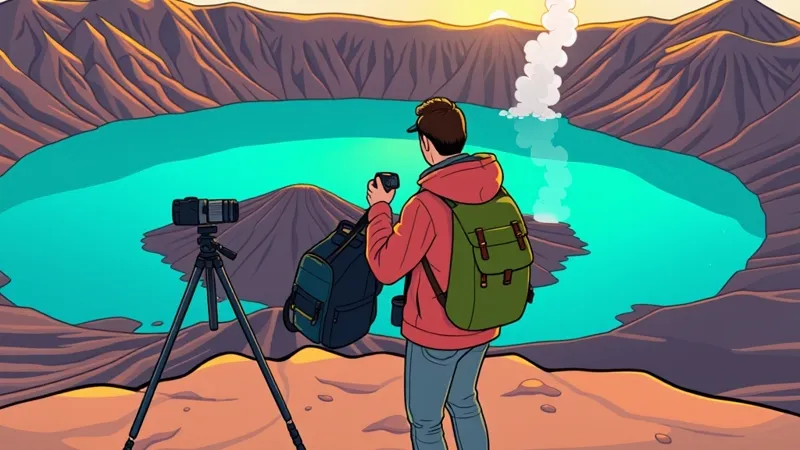
How do you photograph Kawah Ijen’s crater lake at sunrise?
Photograph Kawah Ijen’s turquoise crater lake from permitted crater-rim viewpoints, arriving before sunrise when access allows. Preserve bright sky detail when exposing, and carry a compact tripod plus a closable camera bag. Build the shoot around the rim, sunrise and lake—not a promised blue-fire encounter.
Cloud, volcanic gas and closures can affect both visibility and access. The crater-rim sunrise is the core photographic objective, not a guarantee of clear conditions. Blue fire is only a bonus: visibility depends on gas flow, mining works, darkness and permitted access.
Travel light enough to walk safely. One camera and a versatile lens usually offer more practical value than a heavy collection of equipment. Check visitor notices from BBKSDA East Java, the natural-resources conservation authority, before finalizing your plan.
How long does it take to reach the crater rim with camera equipment?
Allow approximately 1.5–2 hours for the uphill hike, with additional time for registration, rests and photography equipment. These are planning estimates, not promised arrival times.
- Paltuding base camp and trailhead: 1,841 m.
- Trail to the rim: approximately 3 km uphill, steep but non-technical.
- Elevation reference: approximately 2,386 m is the commonly cited mountain/rim figure; it is not a surveyed elevation for every permitted shooting position.
- Elevation gain: approximately 545 m under that route estimate.
- Ascent with camera equipment: start with the 1.5–2-hour estimate and allow longer if carrying weight or walking slowly.
- Banyuwangi town transfer: approximately 1–1.5 hours to the base.
- Bondowoso transfer: obtain a pickup-specific estimate from the provider; do not substitute the Banyuwangi timing.
Confirm the currently permitted route and entry arrangements with BBKSDA East Java. Work backward from sunrise, but never assume opening rules allow your preferred start. The getting-there guide helps separate road travel from hiking time.
When does sunrise light reach Kawah Ijen’s turquoise lake?
Direct sunlight can reach the lake later than the calculated sunrise because surrounding terrain blocks low-angle light. First light on a ridge does not mean the lake below is illuminated.
Calculate sunrise for your visit date and Ijen’s location using the NOAA solar calculator, with the time zone set to Western Indonesian Time. A calculated sunrise is a planning reference, not a prediction of light inside the crater.
Use a flexible sequence:
- Before dawn, photograph rim silhouettes and changing sky color.
- As ridges brighten, look for side-lit crater textures.
- When light reaches more of the basin, reassess the lake’s turquoise color and reflections.
There is no universal best minute or compass-facing viewpoint. Check BMKG, Indonesia’s meteorological agency, for forecasts; haze, cloud and volcanic gas can obscure the lake even after sunrise.
Which camera settings work for the lake, sunrise and handheld photos?
Use RAW capture where available, protect highlights and adapt shutter speed to the available light. The following settings are illustrative starting points, not a fixed recipe.
- Supported daylight landscape: use low ISO and a moderate aperture; adjust shutter speed after checking the histogram.
- Handheld landscape: prioritize a shutter speed appropriate to focal length, subject movement and your steadiness; raise ISO as needed.
- Bright sky above a shaded lake: reduce exposure if important highlights clip. Bracket static compositions when useful.
- Pre-dawn scene: check focus using a magnified preview rather than trusting an indistinct autofocus confirmation.
Moving gas can create ghosting and unnatural edges when bracketed exposures are merged into a high-dynamic-range image. Sometimes a single carefully exposed RAW frame is cleaner.
For phones, lock focus and exposure if supported, then lower brightness enough to retain sky detail. Avoid aggressive saturation that turns the lake fluorescent. Follow your camera manufacturer’s manual for stabilization and focusing behavior; tripod settings are not universal.
Should you bring a tripod to Kawah Ijen?
A compact travel tripod helps with pre-dawn exposures and bracketing, but ordinary sunrise photographs do not always require one. Handheld shooting can be safer and more considerate at crowded or windy viewpoints.
Set up only on firm, permitted ground, keep legs out of walking routes and secure loose straps. Never move toward an edge or improvise an unstable position for a cleaner composition. If wind makes the setup unreliable, pack it away.
A wide-angle lens suits the crater setting; a standard zoom can isolate textures without adding much weight. Confirm current tripod and commercial-photography rules with BBKSDA East Java rather than assuming all equipment use is permitted.
How can you protect a camera from sulfurous gas, dust and condensation?
Minimize exposure: keep equipment in a closed bag between photographs and avoid lens changes near gas or dust. A suitable cover can reduce droplets and particles, but neither covers nor weather sealing make a camera gas-proof.
USGS volcanic-gas guidance explains volcanic emissions and their hazards. Gas combined with moisture is a potential corrosion concern, so do not treat a protective cover as permission to remain in a plume.
Allow gradual temperature transitions to reduce condensation. Before entering a warmer, humid environment, enclose dry equipment and let it acclimatize before opening the bag.
After leaving the site, follow manufacturer-approved exterior-cleaning instructions. Avoid abrasive wiping, improvised chemicals and forcing contamination into openings. Seek professional service if contamination, corrosion or unusual operation is suspected.
What weather and gas precautions matter during a photography hike?
Prepare for cold, wind and changing gas conditions, and stop photographing when safety requires it. Carry warm layers, a wind-resistant outer shell, suitable footwear, a headlamp and a spare battery stored dry.
Temperature planning: rim nights are often described as approximately 2–10°C, but this is not a visit-specific forecast. Check BMKG for the most relevant elevated-location forecast and its elevation; a coastal Banyuwangi reading is not a rim forecast.
Neither a camera cover nor an ordinary dust mask protects against sulfur dioxide. Respiratory equipment does not make a closed or hazardous area safe. Follow ranger or guide instructions and leave affected areas if conditions deteriorate; do not wait for a final frame.
Consult PVMBG’s MAGMA Indonesia volcanic advisories alongside access notices. Cold, lost sleep, sunrise crowds and sulfur irritation are real drawbacks, not incidental details.
Can you photograph blue fire without changing the sunrise plan?
Blue fire should remain an optional addition, never the reason to sacrifice the crater-rim sunrise plan. It is never guaranteed: gas flow, mining works, darkness, weather and access restrictions all matter.
Authorities can suspend crater-floor access, and suspensions can last months. Check BBKSDA East Java and MAGMA Indonesia before booking; never descend into a restricted area.
From a lawful, guide-approved position, start with a wide aperture and adjust ISO and shutter speed to the flame movement and camera support. Check results rather than relying on a universal exposure. Never remain in gas to obtain a frame.
Miners are workers, not photographic attractions. Ask permission before photographing them, obtain consent for identifiable portraits and keep working routes unobstructed.
How do you choose an Ijen tour that allows time for photography?
Choose a tour by its realistic hiking pace and viewpoint time, not by promises of blue fire or perfect sunrise visibility.
Confirm these details with the listed provider:
- Pickup location and expected road-transfer duration.
- Permitted entry time and realistic rim arrival.
- Group size, walking pace and allowance for rests.
- Time available at permitted viewpoints.
- Guide arrangements and equipment provisions.
- Cancellation or itinerary-change terms for closures.
Visit Ijen is an independent editorial and affiliate comparison guide, not a tour operator. Prices and ratings appear through live GetYourGuide widgets on the tour pages, rather than fixed figures in this article.
For a photography-focused decision, compare Ijen tours and ask the provider to confirm shooting time and inclusions. The sunrise versus blue-fire comparison explains the different priorities.
What else should you know about photographing Kawah Ijen?
A light kit and flexible expectations matter more than specialized equipment.
Is a phone sufficient?
A phone is sufficient for daylight crater-lake photographs. Lock exposure where supported and protect sky highlights; see the camera-settings section for low-light limitations and editing advice.
Is a tripod essential?
A tripod is not essential for ordinary sunrise photographs. It helps before dawn, but wind, crowds and visitor rules may favor handheld shooting; see the tripod section.
Does weather sealing protect against sulfurous gas?
Weather sealing does not make a camera gas-proof. Minimize exposure and follow manufacturer cleaning guidance; see the camera-protection section.
When does the lake color photograph best?
The lake often photographs more clearly when useful light reaches the basin and gas or cloud does not obscure it. Terrain delays direct illumination, so calculated sunrise alone cannot identify the best moment; see the sunrise-light section.
Is blue fire guaranteed?
Blue fire is never guaranteed. Gas flow, mining works, darkness and permitted access determine the opportunity; check BBKSDA East Java and MAGMA Indonesia before booking.
Sources
Official access notices, volcanic advisories and location-relevant forecasts should guide your visit planning.
- BBKSDA East Java: visitor access, permitted routes and photography rules.
- MAGMA Indonesia: volcanic advisories from Indonesia’s volcanology authority.
- BMKG: weather forecasts and warnings.
- USGS volcanic gases: volcanic emissions and associated hazards.
- NOAA solar calculator: date-specific solar timing, distinct from terrain-delayed illumination.